Passwords have protected online accounts for decades, but they have also become one of the weakest links in cybersecurity. Weak credentials, password reuse, phishing attacks, and credential theft continue to expose individuals and organizations to significant risks. As cyber threats evolve, businesses are increasingly adopting passwordless authentication methods that eliminate the reliance on traditional passwords while strengthening account security.
A FIDO2 security key offers one of the most effective ways to achieve phishing-resistant authentication. By combining public-key cryptography with the FIDO2 and WebAuthn standards, these hardware-based security devices provide stronger identity verification without sacrificing user convenience. This guide explains what a FIDO2 security key card is, how it works, why organizations are adopting it, and how it supports modern enterprise identity strategies.
What Is a FIDO2 Security Key?
A FIDO2 security key is a hardware authentication device that verifies a user’s identity using public-key cryptography rather than passwords. Instead of transmitting passwords across the internet, the device securely stores cryptographic credentials and signs authentication requests locally.
Unlike SMS verification codes or one-time passwords that can be intercepted or phished, a FIDO2 security key requires physical possession of the device before authentication can occur.
Modern solutions such as the FIDO2 security key combine enterprise-grade security with portability, allowing users to authenticate securely across multiple supported platforms.
What Is a FIDO2 Security Key Card?
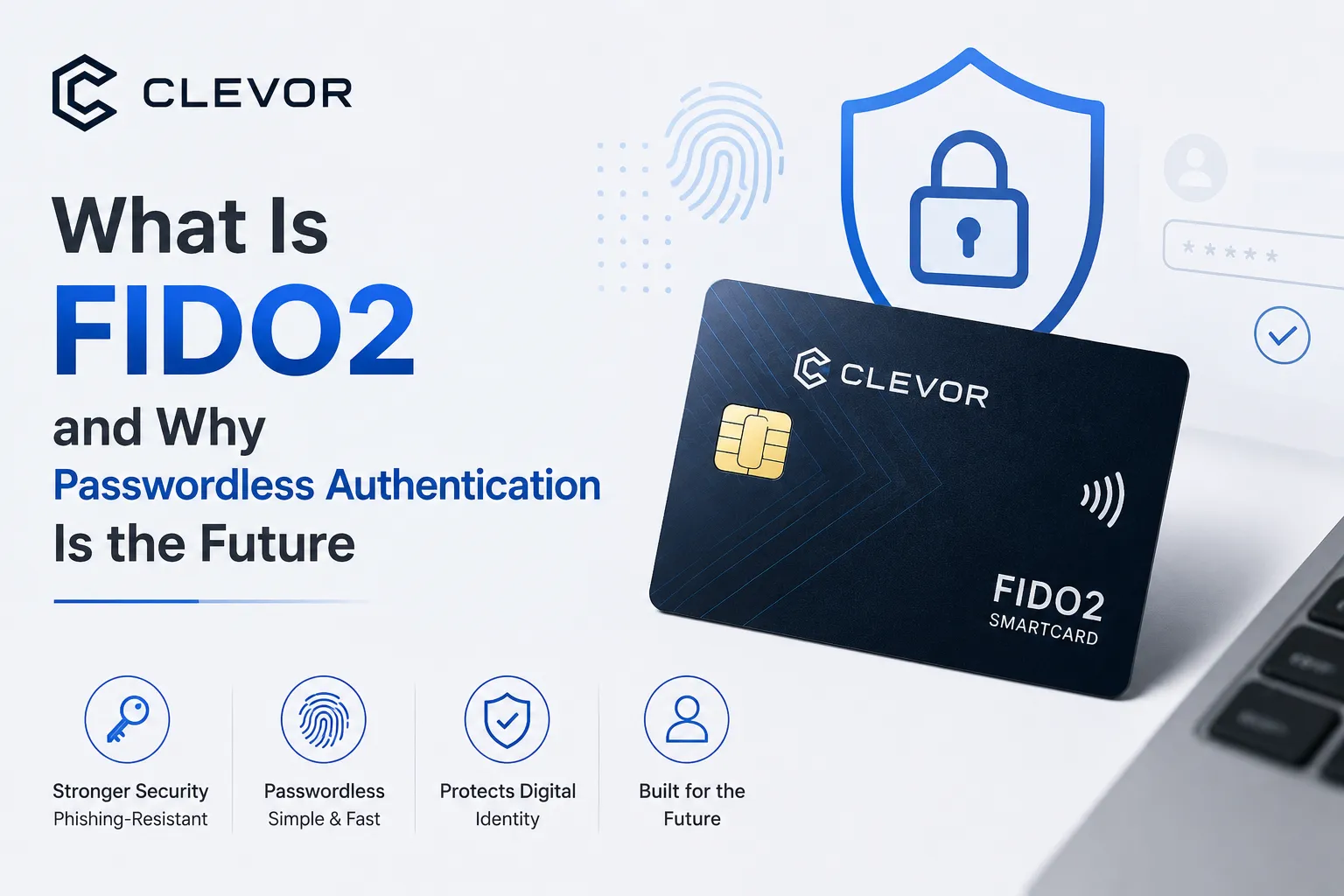
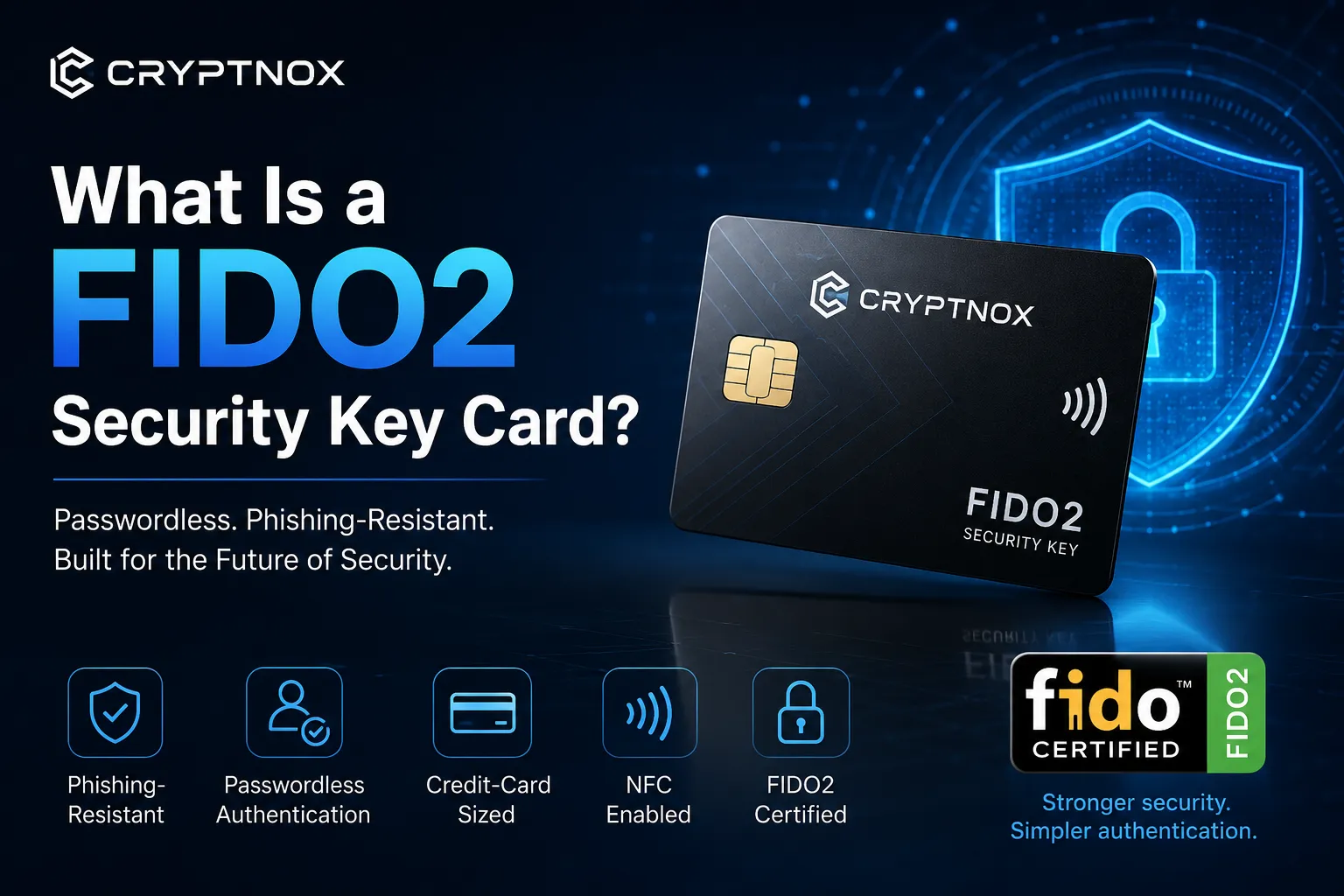
A FIDO2 card delivers the same cryptographic security as a conventional hardware security key but in a slim, credit-card-sized format. Instead of carrying a USB dongle on a keychain, users can keep their authentication credential alongside employee badges, access cards, or payment cards.
Many modern security key cards also support NFC communication, enabling compatible devices to authenticate without requiring physical connectors.
This compact form factor offers several advantages:
-
Easy to carry in a wallet.
-
Durable smart card construction.
-
Convenient NFC authentication on supported devices.
-
Suitable for enterprise identity programs.
-
Simplified employee onboarding and credential management.
How Does FIDO2 Passwordless Authentication Work?
FIDO2 authentication relies on asymmetric cryptography instead of passwords.
During registration:
-
The security device generates a unique public-private key pair.
-
The public key is registered with the service.
-
The private key never leaves the hardware device.
When signing in:
-
The website sends a cryptographic challenge.
-
The device signs the challenge using its private key.
-
The server verifies the signature using the stored public key.
-
Authentication succeeds without transmitting or exposing passwords.
Because each website receives a unique cryptographic credential, stolen credentials cannot be reused elsewhere.
Why Is a FIDO2 Security Key More Secure Than Passwords?
Passwords remain vulnerable to numerous attack methods, including:
-
Phishing websites.
-
Credential stuffing.
-
Password reuse.
-
Keyloggers.
-
Database breaches.
-
Social engineering.
A security key card dramatically reduces these risks because authentication requires both possession of the hardware device and successful cryptographic verification.
Even if attackers obtain your username, they cannot authenticate without the physical security key.
Benefits of Using a FIDO2 Security Key Card
Organizations across industries are replacing password-based authentication with FIDO2-enabled solutions because they provide measurable security and operational benefits.
Phishing Resistance
One of the biggest strengths of FIDO2 is its resistance to phishing attacks. Authentication is tied to the legitimate website’s cryptographic identity, preventing fake login pages from capturing usable credentials.
Strong Enterprise Security
A FIDO2 security key helps organizations protect access to:
-
Microsoft Entra
-
Google Workspace
-
Enterprise VPNs
-
Cloud platforms
-
Internal business applications
-
Developer environments
By eliminating password dependence, organizations significantly reduce account compromise risks.
Improved User Experience
Remembering complex passwords is no longer necessary.
Authentication becomes faster, simpler, and more secure while reducing password reset requests and IT support costs.
Privacy by Design
FIDO2 standards do not require centralized storage of biometric information or reusable passwords.
Instead, each service receives a unique cryptographic credential, improving both security and user privacy.
FIDO2 Security Key Card vs Traditional Authentication
Traditional authentication often relies on passwords combined with SMS verification or authenticator applications.
While these methods improve security compared to passwords alone, they remain vulnerable to phishing, SIM swapping, and social engineering.
A hardware-based passwordless authentication solution removes these weaknesses by requiring cryptographic proof generated directly from the physical device.
For organizations seeking stronger identity protection, hardware authentication represents a significant improvement over legacy MFA methods.
Enterprise Use Cases
FIDO2 security key cards are increasingly deployed across multiple sectors.
Common applications include:
-
Enterprise workforce authentication.
-
Government identity programs.
-
Healthcare organizations.
-
Financial institutions.
-
Educational campuses.
-
Managed service providers.
-
Blockchain and Web3 platforms.
Because many employees already carry identification badges, integrating authentication into a credit-card-sized device simplifies daily workflows while improving security.
Choosing the Right FIDO2 Security Key
When evaluating a FIDO2 solution, consider several important factors:
-
FIDO2 certification.
-
NFC support for compatible mobile devices.
-
Durable smart card construction.
-
Enterprise deployment capabilities.
-
Compatibility with WebAuthn-enabled services.
-
Simple user enrollment.
-
Vendor reputation and long-term support.
Organizations planning large-scale deployments should also consider centralized provisioning, lifecycle management, and employee onboarding processes.
For enterprises seeking a secure, wallet-friendly authentication solution, the FIDO2 card offers an effective combination of portability, strong cryptography, and enterprise-ready usability.
The Future of Passwordless Authentication
Cybersecurity is moving steadily toward passwordless identity systems. Governments, financial institutions, enterprises, and technology providers are adopting FIDO2 and WebAuthn standards to reduce identity-related attacks while improving user experience.
Credit-card-sized authentication devices are becoming increasingly attractive because they combine physical durability with strong cryptographic protection. As organizations continue implementing Zero Trust security models, phishing-resistant hardware authentication will play a central role in securing digital identities across cloud services, enterprise applications, and Web3 ecosystems.
Conclusion
A FIDO2 security key card provides far more than an alternative to passwords—it delivers a modern approach to identity verification built on proven cryptographic standards. By eliminating password dependence, resisting phishing attacks, and enabling secure passwordless authentication, these hardware devices significantly strengthen both personal and enterprise security. Their compact, credit-card-sized design also makes them practical for everyday use, especially in organizations that already rely on employee badges or smart cards. As cyber threats continue to evolve, adopting FIDO2-based authentication is becoming an essential step toward building a more secure, user-friendly, and resilient digital identity infrastructure.